
The Monarch Butterfly Population in Mexico Jumped 64% this Winter
Plus: A bonobo tea party with imaginary juice, why older people laugh less, an ocean art installation in Western Australia, and a moth that looks exactly like a broken twig

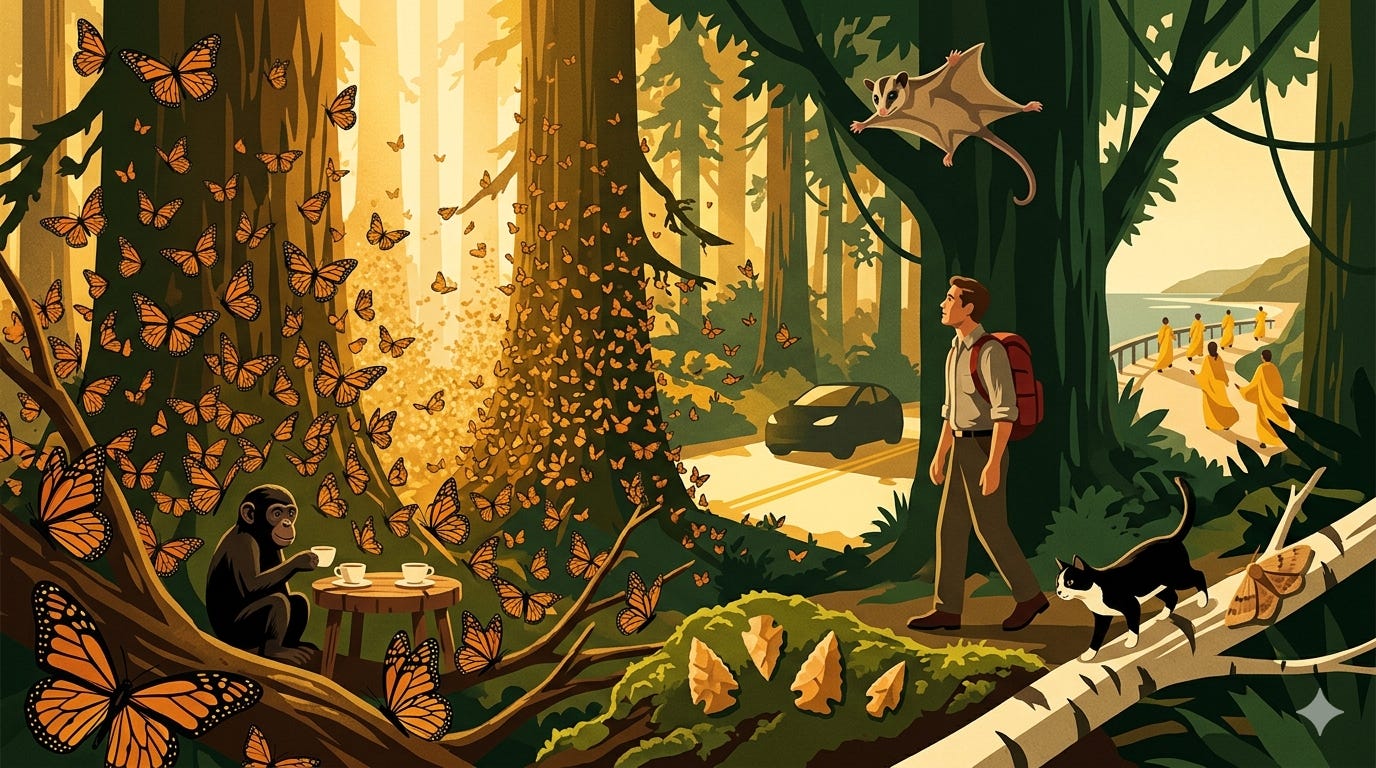
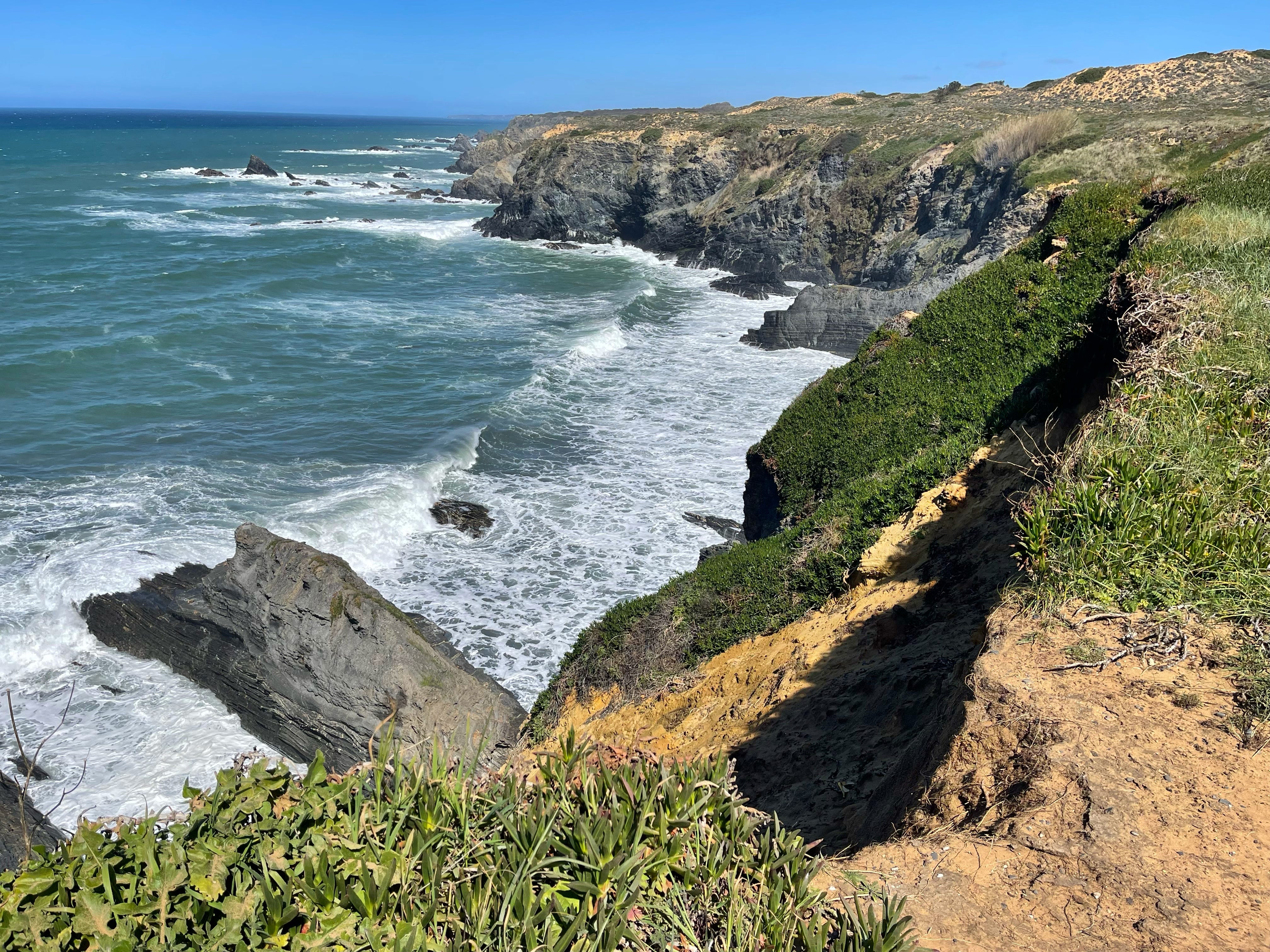
Today, I organized the first of my many notes from the long hikes in Portugal and started writing for The Curious Wanderer, but then I paused the work to focus on today’s Daybreak Notes & Beans; I’ll continue on the Portugal stories tomorrow.
If you want to follow the Fishermen’s Trail with me, I will be sharing those stories in my new travel newsletter, which I launched during the trip but didn’t have time or internet access to fill properly.
Subscribe now, and you will not miss any of it. The Portugal stories are coming, maybe as soon as tomorrow:
What runs through today’s Daybreak Notes & Beans newsletter, though I didn’t plan it this way, is persistence. Monarch butterflies are returning to Mexican forests despite years of neglect. Two marsupials alive in Papua after 6,000 years of assumed extinction. A bonobo named Kanzi has proven that imagination may not be uniquely human. And hunters 60,000 years ago who had already figured out poison arrows, long before anyone thought that was possible.
Let’s start with those monarch butterflies:
Mexico’s monarch butterflies are making a comeback
The monarch butterfly population in Mexico jumped 64% this winter. The area they occupy expanded to 2.93 hectares of forest, the largest coverage since 2018. Every fall, tens of millions of these orange insects travel nearly 3,000 miles from Canada across the US to the mountain forests of western Mexico. Their numbers dropped dramatically over the past 30 years due to habitat loss, herbicide use, and the climate crisis.
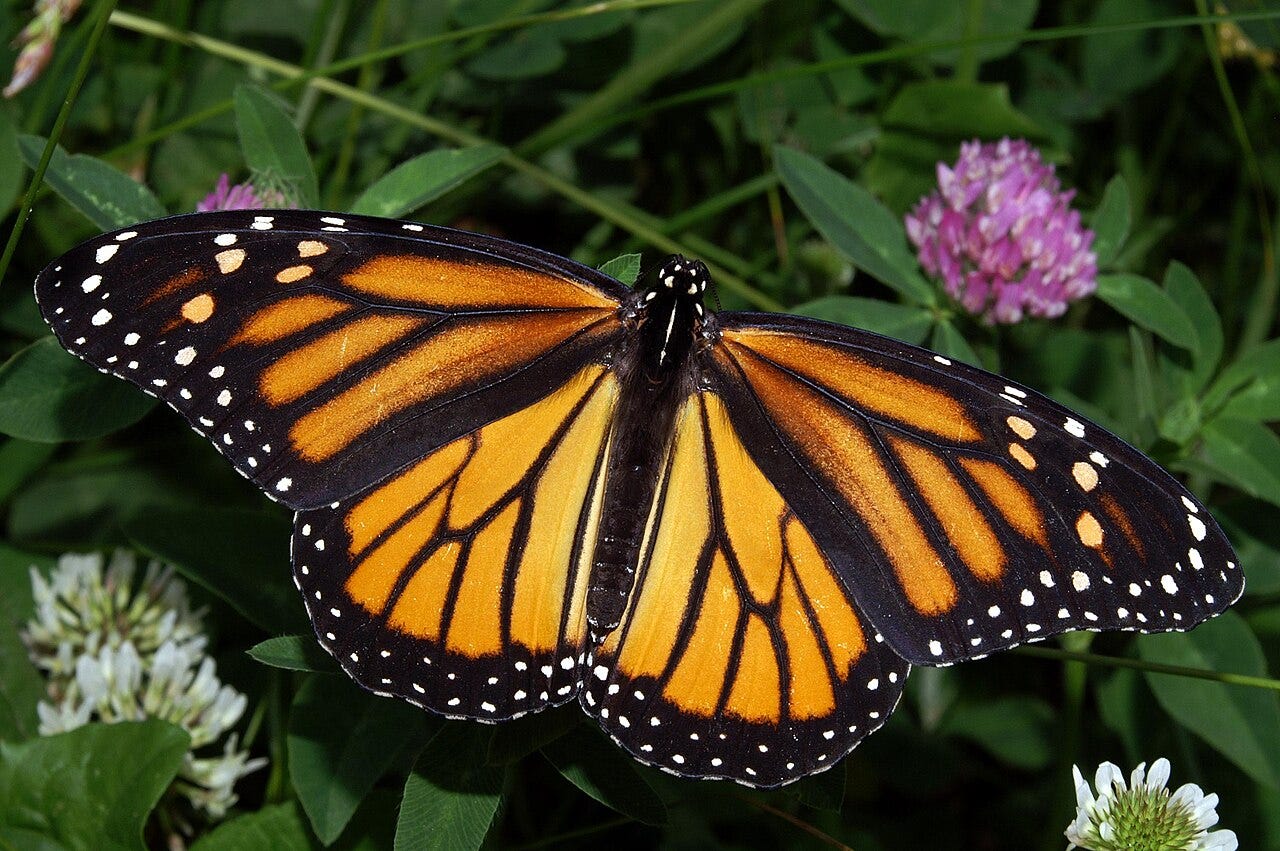
The comeback is real but fragile. At their 1995 peak, monarchs covered more than 18 hectares. Scientists say they need at least 6 for long-term survival. The Trump administration has delayed a Biden-era proposal to list them as threatened, and environmental groups have now sued to force a decision. In Mexico, avocado farming and cartel-driven logging continue to destroy critical habitat.
Conservation work is paying off regardless. Illegal logging in the monarch’s core reserve has been virtually eradicated since 2008. From nearly 500 hectares lost in 2003-2004, just 2.55 hectares were affected between 2024 and 2025.
In Daybreak Notes & Beans, I focus on stories of human ingenuity, conservation wins, art, beauty, and scientific breakthroughs that mainstream outlets often overlook. If these reflections of hope help to start your day with perspective rather than pessimism, consider supporting this work:
Older people haven’t lost their sense of humour
A UK study found that older people use humour less, not because their ability declines, but because opportunities shrink. Researchers interviewed 20 people aged 60 and over and found that isolation, self-censorship, and shifting social norms all play a role. A 75-year-old man put it simply: “As soon as I’m meeting anybody, that’s when the humour surfaces. Not when I’m by myself.”

Many participants said they self-censor around unfamiliar people to avoid causing offence. There is a generational gap too. The dry wit and situational humour they grew up with is increasingly seen as problematic. One 62-year-old summed it up well: “I like laughing at situations, not at people.”
The study also found a link between humour and wellbeing. People who used humour socially rated themselves happier. Those who used it defensively, as a mask, tended to report lower wellbeing and fewer meaningful connections. Laughter needs company. When regular social contact fades, so does one of the most effective tools for getting through the harder parts of life.
A bonobo hosted an imaginary tea party and understood the rules
A bonobo named Kanzi sat down at a table with two glasses. A researcher brought out an empty pitcher and pretended to fill both glasses with imaginary juice. Then she poured the pretend juice from one glass back into the pitcher. She asked Kanzi which glass was still full. He got it right more than two out of three times. Not guessing. Playing along.
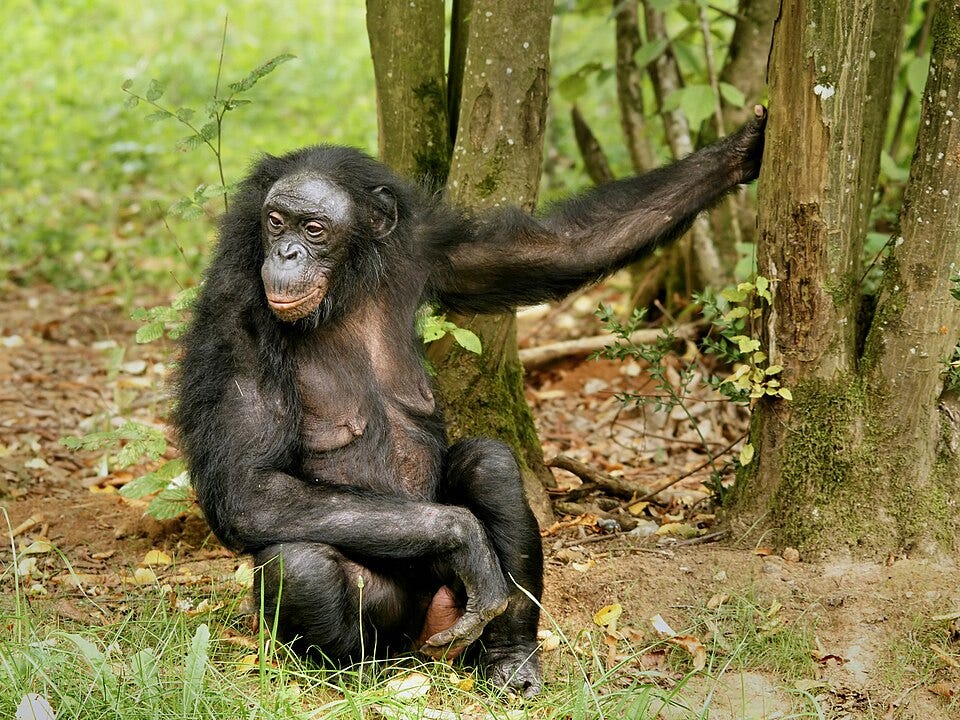
Kanzi had spent his life communicating with scientists using symbol boards called lexigrams. He was already remarkable. But this experiment, published in Science in February, showed he could track imaginary objects and keep them straight in his mind. Researchers then offered him a choice between real juice and pretend juice. He picked the real one almost eight out of ten times. He could see the difference. He just chose to play the game anyway.
Kanzi died in March 2025, just two months after researchers last saw him. Scientists now want to find out whether apes raised without human contact can pass the same test. The tea party may be evidence of capacities far older than anyone assumed.
Electric cars kept 2.3 million barrels of oil in the ground every day last year
Global electric vehicle adoption displaced 2.3 million barrels of oil per day in 2025, according to new research from BloombergNEF. That is oil that was never pumped, never refined, never burned. And the figure is expected to grow every year for the rest of the decade. By 2030, the same researchers project daily avoided consumption could more than double, reaching 5.25 million barrels.

This matters beyond the climate numbers. It represents a structural shift in energy demand that no single policy created. Drivers around the world are choosing electric vehicles because the economics increasingly make sense. Cheaper to run, cheaper to maintain, and in many markets now cheaper to buy. The transition is happening because it works, not only because governments pushed it.
Trump is doing everything he can to slow this in America. Cutting EV incentives, rolling back emission standards, talking up oil as if it’s 1975. Europe and China are moving in the opposite direction. The world is changing. American policy is just deciding whether the US auto industry will be part of that future or spend the next decade catching up.
Two marsupials thought extinct for 6,000 years turned up alive in Papua
Scientists working with Indigenous communities in the Bird’s Head Peninsula of Indonesian Papua have found two marsupial species believed extinct for the past 6,000 years. The pygmy long-fingered possum is a palm-sized striped animal with one finger twice as long as the others. The ring-tailed glider is a tree-dwelling possum about the size of a squirrel, with large eyes and a membrane that lets it glide between trees. Both were known only from fossil records until photographs confirmed they are very much alive.
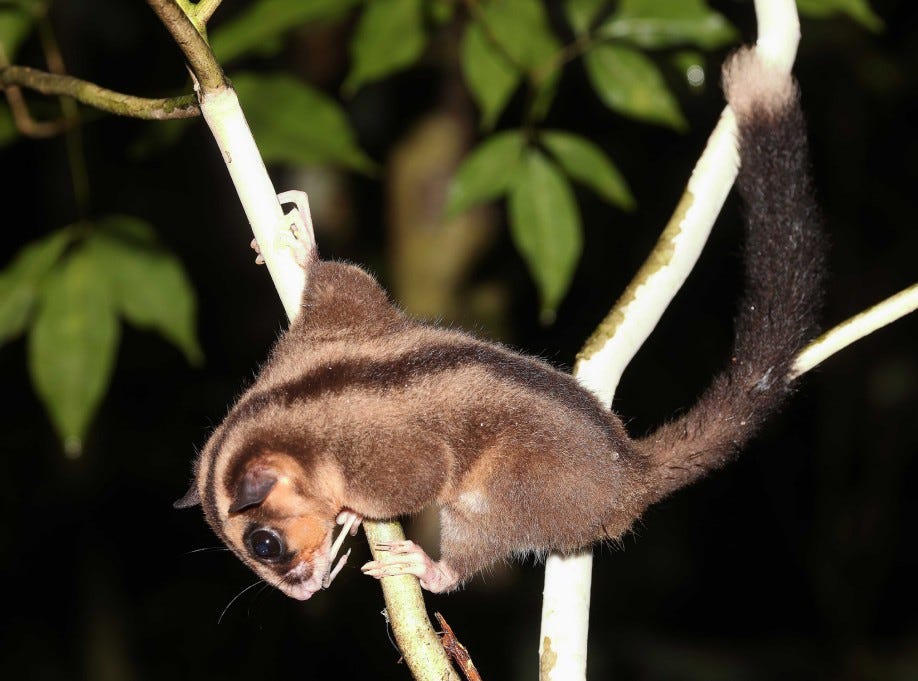
Local Indigenous residents had never lost track of them. The ring-tailed glider, known locally as Tous, is considered sacred and central to initiation practices in Maybrat communities. Without their cooperation, the researchers say, the identification would not have been possible. Biologist Tim Flannery from the Australian Museum described seeing that first photograph as feeling like he had traveled back in time.
Flannery believes there are almost certainly more Lazarus species waiting to be found in these forests. The Bird’s Head Peninsula remains one of the least studied biodiversity hotspots on the planet. The forests that no one studied turned out to be the ones worth protecting.
Your subscription supports independent journalism that refuses to surrender to negativity.
Tiny footprints are revealing which small mammals live where
Scientists have developed a method to identify small mammals by their footprints, with 94 to 96 percent accuracy. They tested it on two species of sengi, small insectivores native to Africa that look almost identical. Currently, the only reliable way to tell them apart is DNA analysis, which is slow, expensive, and stressful for the animal. Footprints turn out to work better.
I wrote about this research not too long ago, but while hiking along the Portuguese coast, I came across a German hiker who recognized many of the footprints we stumbled upon. So I told him about the sengi research, and he hadn’t heard about it yet. Earlier today, I looked up more information and thought I should share it with you as well:
The researchers collected sengis from South African nature reserves using traps baited with oats, peanut butter, and Marmite, which the animals apparently find irresistible. After walking through charcoal dust, the sengis left footprints on special paper. Scientists then scanned those prints and trained a model on more than a hundred possible features, narrowing it down to nine that reliably distinguish the two species.
Small mammals are crucial ecosystem indicators. Their populations signal early when something is going wrong in an environment. But they are notoriously difficult to monitor. A tool that works from footprints alone, no trapping required, no lab tests, could change that completely. The team plans to expand the method to other species. As one researcher put it, small mammals exist in almost every ecosystem on the planet, and the technology is flexible enough to follow them wherever they are.
If you have a moment, check out WildTrack's website to learn more about their fascinating work.
The world’s smallest QR code fits inside a bacterium
Scientists at Vienna University of Technology have created the world’s smallest QR code, covering just 1.977 square micrometers. That is smaller than some bacterial cells. Your phone cannot scan it. You would need an electron microscope. The team won a Guinness World Record in December 2025, and their creation is about one-third the size of the previous record holder.

The key was printing the code onto a thin ceramic film using focused ion beams, cutting pixels just 49 nanometers in size. That is ten times smaller than the wavelength of visible light. The code is completely invisible to the naked eye but fully readable when scanned with the right equipment.
The practical ambition goes beyond record-breaking. The researchers estimate their ceramic storage method could hold more than two terabytes of data in a single A4-sized sheet. Ceramic is also remarkably durable. One of the scientists compared it to ancient inscriptions still legible thousands of years later. The goal is data storage that lasts, takes up almost no space, and leaves a smaller environmental footprint than conventional options. Quite a lot to ask of an object invisible to the naked eye.
Hunters used poison arrowheads 60,000 years ago in South Africa
Researchers have found evidence that humans coated arrowheads with plant-based poison at least 60,000 years ago, more than 50,000 years earlier than scientists previously thought. A team analyzed five quartz arrowheads unearthed in the 1990s at a rock shelter in KwaZulu-Natal, South Africa. Traces of a poison derived from gifbol, a flowering plant also called the poisonous onion, were still detectable on the surface after six decades in the ground.
What makes the finding even more striking is the continuity. A Swedish naturalist traveling in southern Africa in the late 1700s collected arrowheads from local hunters coated with the same plant-based poison. The identical substance, separated by more than 50,000 years. Whether this reflects an unbroken tradition or independent rediscovery, scientists are not yet sure.
The researchers point out that using poison requires planning ahead. The hunters had to identify the right plant, extract the toxic compound, apply it carefully, and then track prey that would not die immediately. That level of causal reasoning pushes our understanding of early human cognition back considerably. These were not people stumbling through survival. They were thinking several steps ahead.
A moment of science
A moth in the genus Phalera rests on your hand and you see a broken piece of twig. Not approximately. Exactly. The buff-colored “cut end” mimics exposed wood. The grey, streaked wings read as chipped bark. Hold it up and your brain keeps registering it as debris rather than a living insect.
This is the buff-tip moth, found across Europe and parts of Asia. When at rest, it wraps its wings tightly around its body into a cylindrical shape. The head matches the wing tips in color, so the entire insect reads as a single fragment of broken birch rather than anything alive. Birds fly past without a second look.
The camouflage evolved over millions of years. Moths whose patterns happened to look more like wood survived. Birds flew past. Genes passed on. Repeat long enough and you get perfection. Watch the video. See how long it takes before you spot the moth.
A moment of beauty
In early March, Indian artist Subodh Kerkar brought 100 people to Cottesloe Beach in Western Australia, dressed in yellow gowns, and asked them to move like waves. Shot from a drone, the installation is called Ocean Odyssey. It looks like sunflowers rippling at the ocean’s edge, a tribute to what Kerkar calls the romance between sea and sky. He trained as a doctor before dedicating his life to art. The ocean has been his subject ever since.
Stay inspired,
Alexander
Daybreak Notes & Beans is different. While most news is often depressing these days, this newsletter brings you stories that inspire and make you smile.
Subscribe to receive daily hope in your inbox, access our full archive, and join a progressive community that believes good news matters.

More from Alexander Verbeek:
The Curious Wanderer: Travel writing, trail photography, and more personal updates from wherever I happen to be. This one is not like my regular newsletters; here you’ll find articles I used to publish only for my small, supportive community on Patreon. Publishing will be irregular. Sometimes daily, when I am traveling. Sometimes quiet for weeks when I am not, and focus on the other newsletters. It’s the most personal of all my channels.

The Planet: My political newsletter, written from a European perspective. Analysis of democracy, power, and what’s happening in Trump’s America — with historical parallels and the kind of clarity that distance from Washington can bring.

More: My digital notebook. Follow-ups to stories I didn’t have space to finish, reader questions answered properly, personal moments, and things that don’t fit anywhere else. No fixed format. Published when there’s something worth your time.

Screen Skills: A tech-newsletter for non-tech people. Short, practical digital literacy guides for people who want to use their devices with more confidence. No jargon, no condescension. Usually, I publish it every other working day.

Notes
Monarch butterflies: Oscar Lopez, The Guardian, ‘Mexico’s monarch butterfly population jumps 64%, offering hope for at-risk species’ - https://www.theguardian.com/world/2026/mar/20/mexico-monarch-butterfly-population-increases
Older people and humour: Heather Heap, The Conversation, ‘What humour means to older people – and why some find it hard to keep on laughing’ - https://theconversation.com/what-humour-means-to-older-people-and-why-some-find-it-hard-to-keep-on-laughing-278038
Bonobo tea party: RJ Mackenzie, Science News Explores, ‘A bonobo’s imaginary tea party hints that apes can pretend’ - https://www.snexplores.org/article/kanzi-bonobo-play-pretend
Electric vehicles: Akshat Rathi & Laura Millan, Bloomberg, ‘EVs Avoided the Use of 2.3 Million Barrels of Oil Per Day in 2025’ - https://www.bloomberg.com/news/articles/2026-03-18/electric-vehicles-avoided-use-of-2-3-million-barrels-of-oil-daily-in-2025
Lazarus marsupials: David Brown, Mongabay, ‘Two marsupials thought extinct for 6,000 years found alive in Indonesian Papua’ - https://news.mongabay.com/short-article/2026/03/two-marsupials-thought-extinct-for-6000-years-found-alive-in-indonesian-papua/
Sengi footprints: Angharad Brewer Gillham, Frontiers, ‘96% accurate footprint tracker for tiny mammals could help reveal ecosystem health’ - https://www.frontiersin.org/news/2026/01/27/96-percent-accurate-footprint-tracker-tiny-mammals-frontiers-ecology-evolution
World’s smallest QR code: Carly Cassella, Science Alert, ‘World’s Smallest QR Code Is So Tiny It’s Invisible to The Human Eye’ - https://www.sciencealert.com/worlds-smallest-qr-code-is-so-tiny-its-invisible-to-the-human-eye
Poison arrowheads: Tom Metcalfe, Science News Explores, ‘60,000-year-old poison arrowheads show early humans’ hunting tactics’ - https://www.snexplores.org/article/oldest-poison-arrowheads
Buff-tip moth: Phalera bucephala, genus Phalera, camouflage and natural history
Ocean Odyssey: Subodh Kerkar, Instagram @subodhkerkar, ‘Ocean Odyssey Cottesloe,’ Sculpture by the Sea, Cottesloe, March 9, 2026
"I wrote about this research not too long ago, but while hiking along the Portuguese coast, I came across a German hiker who recognized many of the footprints we stumbled upon."
Fascinating! Looking at WildTrack's website now 🐾
So appreciative of scientists and citizens watching for animal species thought extinct and now appearing among us.
Monarch numbers climbing is so encouraging. They receive help along the way from monarch lovers who set up waystations providing: sun, wind shelter, water, milkweed, goldenrod, abd flat stones. We're with you beautiful butterflies.
Europe and China know what's best. Go EV use!
Bonobo Kanzi's story reinforces the evidence that animals enjoy play.
The beauty of the Ocean Odyssey installation 💛
Wonderful news about the Monarch butterflies! I love the illustration introducing today’s DNB. Even the tiny
Buff-tip moth is pictured!
The bonobo story of the tea party was fun to read about…
I find it very depressing that our government could be using as much as 2.3m barrels of oil per day (as measured in 2025) compared to saving those by switching to EVs. 47 has a mis-guided passion
for fossil fuels. That and his “war of choice” involving oil consumption worldwide is going backwards…
The Brits have always had a wonderful sense of ‘humour’! I enjoyed reading about it today. The sunflower 🌻 Ocean
Odyssey was simply beautiful😊